Getting Started on Your Canoeing Journey

Basic Canoeing Skills and technique
A few basic skills can go a long way when canoeing:
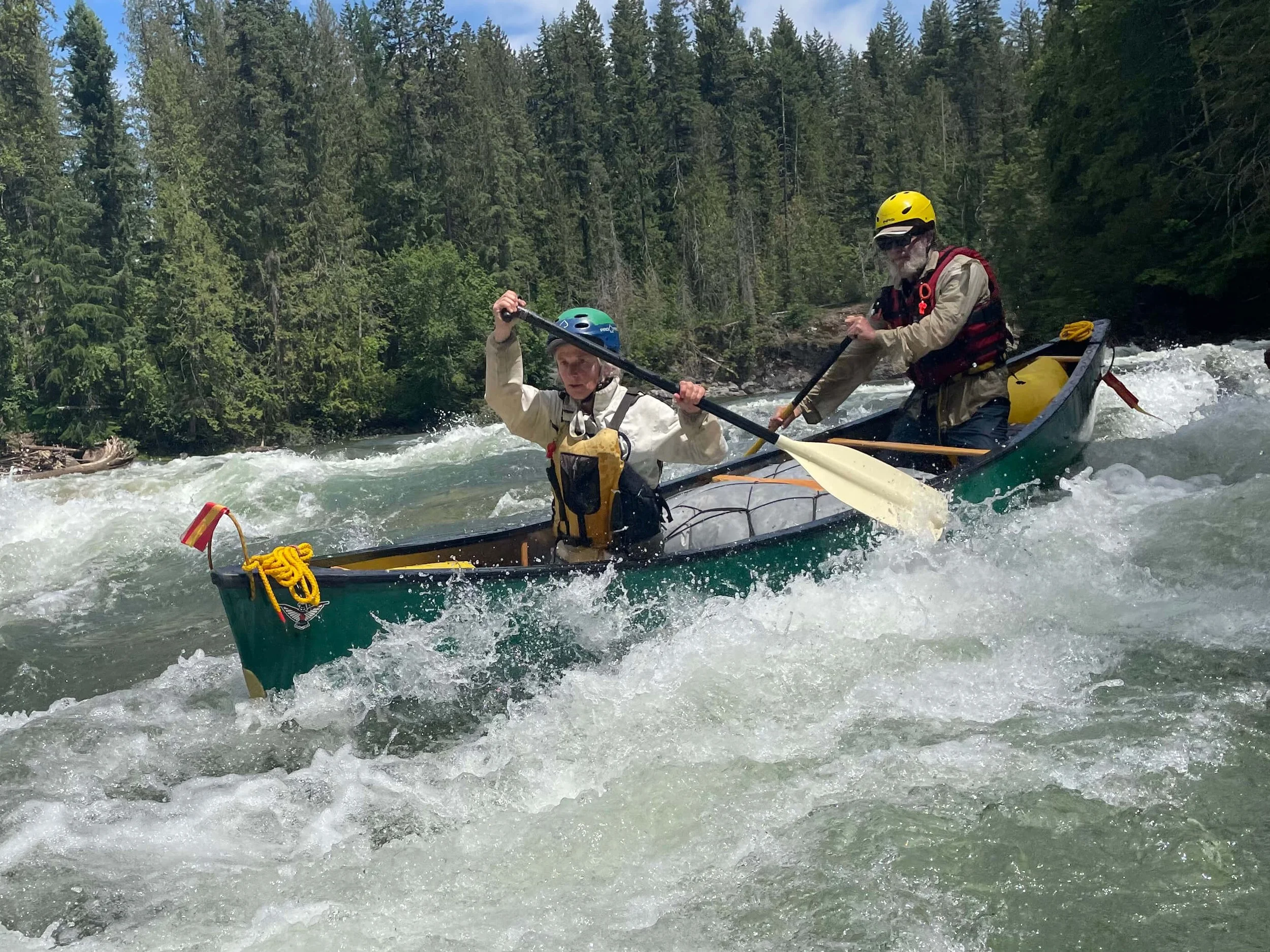
Paddle on opposite sides as much as possible to balance and minimize steering strokes.
The stern paddler should use a J-Stroke & Sweep for the lake or a river-J & stern pry on the river to steer.
The bow paddler can assist with steering or sharp turns using draws, prys, or sweep strokes.
Kneel for stability whenever needed such as in waves, rapids, or during rescues.
Learn to brace your canoe with your paddle. Don't grab the gunwales! Hold onto that T-Grip!
If you are soloing, sit on the bow seat facing backwards or toward the middle of the canoe to trim it.
Trim your boat level or slightly bow-light except in a headwind, then trim it slightly bow-heavy.
Try to paddle using your torso (abdominal and back muscles). Only slightly bend your arms, and try to reach forward and get a good catch with the blade before you pull. No lilly-dippy - no splishy-splashy!
Canoe Equipment Basics
Any canoe is better than no canoe!
Don't let anyone get you down for paddling what you can afford. However, using the right canoe for the right purpose makes a big difference. And you get what you pay for... a lighter, faster, better outfitted canoe will make your paddling more efficient, safe and enjoyable. Check out our Safety and Trip Planning Page for more info on the basics of canoe design and construction.
Finding the Right Course
Finding the right course can be a little confusing but we're here to help. The RCABC has a diverse set of canoeing disciplines and course types to support paddlers at different stages.
Explore Canoeing Disciplines
Most disciplines include Basic and Advanced levels, and some also include additional streams or specialty training.
Click on each discipline below to learn more.
Lakewater (Basic and Advanced; Solo and Tandem & Lakewater Leader)
Moving Water (Basic, Advanced and Playboating; Solo and Tandem)
Poling (Lakewater, Basic, and Advanced)
Big Canoe (Voyageur) (Paddler and Leader)
C-1 (Rolling and Rescue clinic, Basic, Advanced and Playboating)
Canoe River Rescue (Foundations and Swiftwater Canoe Rescue Technician (SRT))
Tripping (Paddler and Leader)
Guiding (Day Guide and Expedition Guide)
Ocean Canoeing (Basic and Advanced)
Instructor Courses
Lakewater and Moving Water disciplines also have Instructor courses taught by Instructor Trainers or Master Instructors. For most other disciplines Instructor certification is only granted via mentorship.
So if you are using the Find an Instructor tool look for someone with that designation. Contact the instructor coordinator for more help.
Where do I start?
Generally most people start with Lakewater Basic Tandem which are often offered inexpensively by local clubs. Then paddlers take basic and advanced courses in other disciplines as they desire. For example Moving Water or Tripping if you plan to paddle river trips and Ocean Canoeing courses if you are a coastal paddler.
For many advanced or specialized programs you may need to book with a professional paddling school. Technically, you can enter at any course level at the instructors discretion depending on your previous skills and experience.
If you have questions about what course is right for you ask your local Instructor, Zone Rep or the Instructor Coordinator at instructor_coordinator@bccanoe.com.
The following flowchart may be useful in visualizing the RCABC's course offerings and certification levels.